How architectural dreams went unbuilt at SFSU
Political resistance killed Moshe Safdie’s experimental student union and funding issues later derailed Michael Maltzan’s performing arts center
Neal Wong • Aug. 22, 2025 • Published in Golden Gate Xpress
This October, the Cesar Chavez Student Center will turn 50 years old — half a century of housing student life within its distinct concrete structure. In the 1960s, a very different, distinct, concrete building was close to being built.
The architecture at San Francisco State University tells the story of how the school has changed, but it’s an incomplete narrative. Filed away in the J. Paul Leonard Library and architects’ offices are the stories of buildings that never rose from the ground. These unbuilt ideas reveal how politics, economics and changing priorities have shaped the campus.
Student Union by Safdie Architects
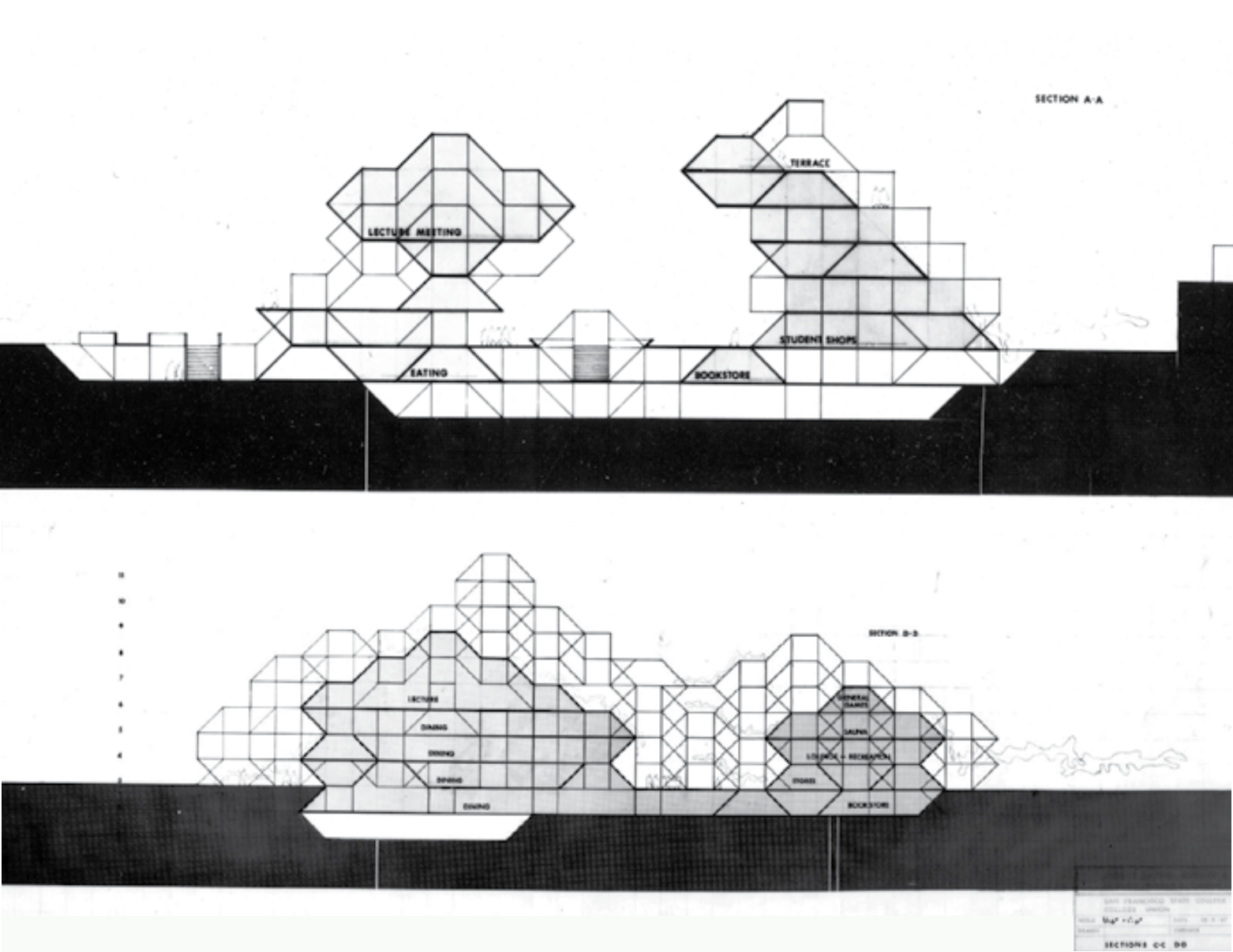
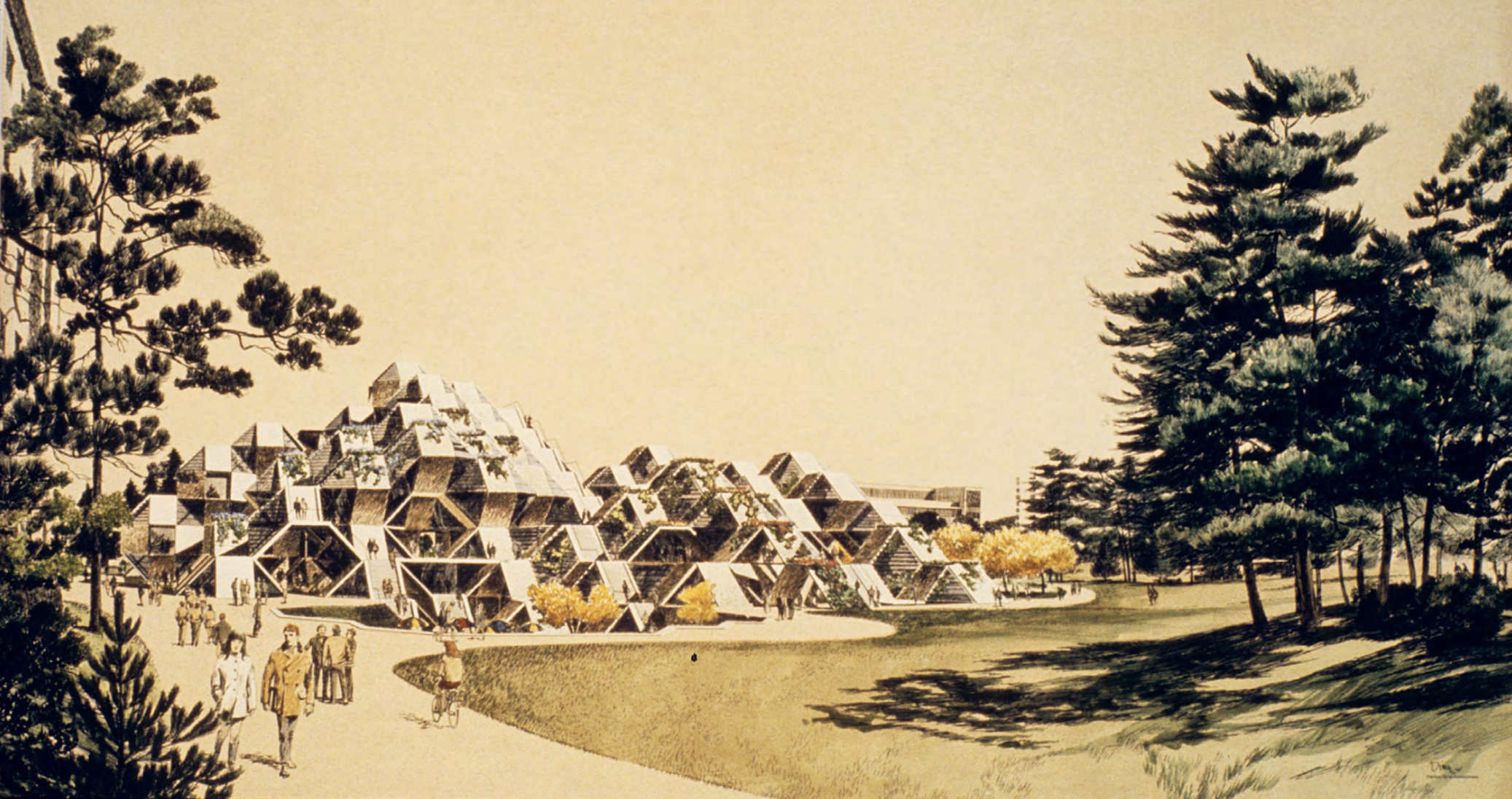
Moshe Safdie, founding partner of Safdie Architects, conceived his student union as a departure from the utilitarian architecture of the school — which was then known as San Francisco State College. The design featured prefabricated modules that could be combined to create spaces ranging from small meeting rooms to large auditoriums.
“The site was critical — it was in the middle of the movement system, and I wanted to design a building that you could walk through in several directions,” Safdie told Golden Gate Xpress.
At the time, Nancy McDermid, former dean of the College of Humanities (a predecessor to the College of Liberal and Creative Arts), was an associate professor of speech (now communications). She was part of the committee for the building.
“We had some of the top architects in the world come — Safdie from Canada, [Paolo] Soleri,” McDermid said.
Safdie and 49 other architects received a letter from Associated Students. It read, “We want a building or buildings about what students are about — generous, exorbitant, energetic, anxious, frivolous, raw, shy, and with some secret spaces and some intricate spaces.”
According to his 1970 book “Beyond Habitat,” he had already known of the school’s reputation.
“San Francisco State had the reputation of being one of the most radical and active campuses in the U.S., more radical in many ways, I feel, than Berkeley,” Safdie wrote.
The Israeli-Canadian-American architect reflected on his visits to the campus to see the site and meet students and faculty.
“Something immediately resonated in me when I arrived on the campus,” Safdie wrote. “The students were a complete mixture: long and short hair, left and right, radical and content. The campus grounds at lunch time looked like a biblical pasture. I felt very much at home, very comfortable. I have often flown from meetings on that campus direct to Washington for meetings with HUD officials, and the contrast was almost too much to bear. It was like flying from one country to another.”
When he was called to design the building, he was both “thrilled, and frightened to death.”
Safdie reflected on the design of the building in his 2022 memoir, “If Walls Could Speak: My Life in Architecture.”
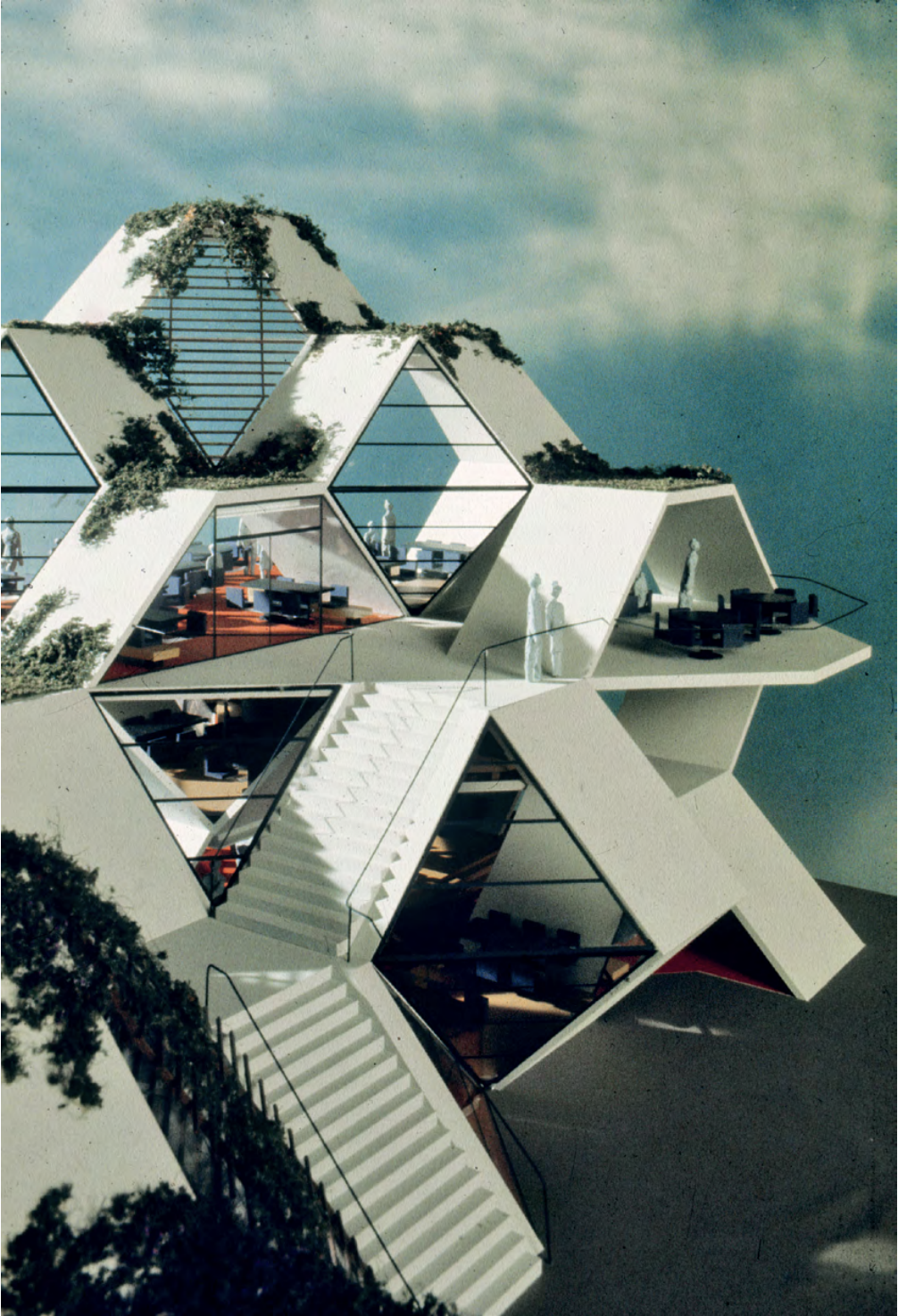
“I was almost the same age as some of the students, and the chemistry was good,” Safdie wrote. “The design that evolved was radical: a structure assembled from precast forms that were bent, stacked, and clustered to form a hill-like building you could climb over, walk under, or enter directly. Many of the inclined surfaces on the exterior were given over to stairways, and much of the rest of the exterior was planted with grass.”
The modular approach drew from Safdie’s famous residential complex in Montreal — Habitat 67 — which looks like a conglomerate of concrete cubes. Each octagonal unit was designed to be prefabricated off-site and assembled on campus.
“I was at the time involved with modular construction. I had just finished Habitat, which was prefabricated boxes — quite elaborate and heavy,” Safdie said. “I thought that the idea would have some kind of building block which is prefabricated and standardized, out of which we would get the smaller rooms, the larger rooms, the auditorium.”
Back in 1968, the Daily Gater, the name of the campus newspaper at the time, reported that the project would’ve been built in two phases and was estimated to have cost $7.12 million in total — roughly $64 million today. It would’ve been paid for by student fees.
The design created practical challenges. The sloping walls of the modules posed issues for interior spaces.
“A sloped wall has an underside, and most of the rooms had a vertical face before they went into the slope,” Safdie said. “If a room started with the slope, you’d have to keep people away or block that space because they didn’t have headroom.”
Safdie said this would have been resolved during the detailed design phase, but the project never progressed that far.
Ricardo Gomes, professor in the School of Design, said the building exemplified 1960s architectural optimism about modular construction and geometric forms.
“In 1967, this was what the future looked like,” Gomes said.
However, Gomes identified a major flaw that would pose problems: accessibility. The building’s emphasis on stairs and climbing would have excluded students with mobility limitations.
“Everything is connected by stairway,” Gomes said. “If someone’s in a wheelchair, this would not be an accessible space.”
The California State College (predecessor to the California State University) Board of Trustees rejected Safdie’s design despite approval from fire safety inspectors and structural engineers. The decision came during a period of intense campus activism.
“My first reaction was disbelief,” said Safdie of learning about the rejection. “Elderly gentlemen — I felt they were elderly, I was 30 to 40 years younger than them — the idea that this was hippie architecture and things that were said were quite insulting.”
McDermid remembers the reasoning from the trustees.
“They said that Safdie’s design was not compatible with the architectural design of the campus,” McDermid said. “We certainly laughed and all the rest, because what was the architectural design of the campus? We had all kinds of names for it — Neanderthal, whatever.”
Before the Third World Liberation Front Strike, students and faculty were already working together for change in education, according to McDermid. She said that having a committee for the building was just another thing that upset the trustees.
“That the design was not compatible with the architectural spirit of the campus was simply another putdown on the participation of those who were most affected by the design of the union,” McDermid said.
Meredith Eliassen, special collections librarian, agreed the rejection had political motivations.
“In my opinion, it appears to be retaliatory for activist student government that goes deeper than the protests,” Eliassen said. “The Associated Students garnered power through their Experimental College, which was innovating curriculum.”
Safdie said the rejection reflected broader cultural tensions of the era.
“It was of the time — there was a rising spirit which was seen as radical, and there were conservative gentlemen who saw this for some reason as threatening,” Safdie said.
Despite being designed more than half a century ago, Safdie believes the student union would resonate with today’s students.
“People would be as excited about this building today as it would have been 50 years ago, which is actually the ultimate test for architecture,” Safdie said. “Can it maintain its relevance over a period of time?”
Safdie said he would keep the concept largely the same if he designed it today.
The Cesar Chavez Student Center that stands now was designed by one of the other 49 people who received the letter from Associated Students.
According to architect Eric Keune’s book “Paffard Keatinge-Clay: Modern Architect(ure)/Modern Master(s),” Safdie was one of seven finalists in the original contests for the building’s design. After the state college trustees rejected Safdie’s design, the other six finalists were invited back.
Keatinge-Clay’s design won the second contest and opened in 1975.
Mashouf Performing Arts Center by Michael Maltzan Architecture
Students walking past the Mashouf Wellness Center today see an exercise facility with pools and a climbing wall. Fourteen years ago, there was a radically different vision for this site: a colossal performing arts center.
Michael Maltzan designed a complex with four performance spaces. He envisioned the performing arts center as a transparent building that would showcase creative activity to passersby. It was designed to achieve a LEED Gold rating. LEED is a system to categorize sustainable architecture.
“The university was looking to consolidate a number of their performing and broadcasting arts into one building, along with theater spaces,” Maltzan said.
The center would have served as a gateway into the university.
“The building would have appeared to have been a very large, floating one-story building, mostly glass on the exterior, so that as you pass by, or as you approached, you could see all of the life activity going on in the building,” Maltzan said. “It was meant to be a kind of creative incubator space, a kind of beehive of cultural and creative energy.”
The design’s performance venues ranged from a 1200-seat space to a 250-seat black box theater.
“We spent a great deal of time thinking about how they would work, what that character would be on the inside of the spaces, but also how they would pop up through the building and be more visible from around the campus,” Maltzan said.
Central to Maltzan’s vision was the idea that the building would function like a small campus, encouraging chance encounters between students and faculty from different disciplines.
“So much of the life of the campus — the intellectual, as well as the social life — happens when you’re walking from class to class, when you’re walking across one of the quad spaces,” Maltzan said.
The building was designed to blur the boundaries between different arts programs that had been physically separated.
“You had the opportunity to see other people working and doing the things that they were focused on,” Maltzan said. “For instance, if you were coming to use a rehearsal room, you might have passed by the broadcast studios and seen that work going on.”
At the time, university leaders reacted with awe.
“The University has always been a powerful incubator for artistic talent, as evidenced by the success of so many SF State graduates,” said former university president Robert Corrigan, to SF State Magazine in 2011. “Now, the Mashouf Performing Arts Center sets the stage for even greater possibilities and achievements.”
Kurt Daw was the dean of the College of Creative Arts, which existed before SFSU’s colleges were consolidated to save money.
“I think it’s the most incredible vision for arts education unfolding in the U.S. right now,” Daw told Golden Gate Xpress in 2011.
According to Kim Schwartz, director of the School of Theatre and Dance, faculty weren’t as impressed. She participated extensively in planning meetings from 2007 through the project’s cancellation around 2011 and saw design flaws that would have hampered theater operations.
“The scene shop was in the basement, but they didn’t design a freight elevator into the building so that we could receive large materials at the dock and transport them to the basement,” Schwartz said. “One thing that could be improved from the current Creative Arts building is that the costume shop needs windows — they did not address that.”
The fundamental problem, according to Schwartz, was a disconnect between the architect’s vision and the practical needs of end users.
“The biggest problem that I saw through that process was the architect didn’t listen to us — the end users,” Schwartz said. “It was really frustrating. Even the theatrical consultants that were hired by the architects were frustrated.”
The project was planned as a three-phase construction beginning with the largest theater at the campus edge near the golf course. Maltzan’s firm had progressed well into design development when economic conditions shifted.
“We were well into the design and the development of the design — ultimately, the documents that would have led to construction,” Maltzan said.
The funding structure relied heavily on state bond financing, which became problematic during the recession. The project lost momentum when it didn’t seem financially feasible.
“The economic downturn made it very difficult for the university,” Maltzan said. “The bonds go to vote, so people in the state would have voted for or against the bonds and given the state of the economy, it wasn’t a good time.”
Philanthropists Manny Mashouf and Neda Nobari, both SFSU alums, had donated $10 million to the building. The donation was redirected to what became the wellness center.
Gomes remembered the project cancellation.
“They ran out of money, and Mashouf [Wellness Center] was going to be cheaper, and they already had the money to do that, and they had to use the money,” Gomes said.
Gomes noted that the university may have been wise to avoid the ongoing costs of operating a major performing arts facility.
“In order to sustain such a complex, they’d have to be 24/7, and they’d have to have more staff or more investment than the university itself alone,” Gomes said.
Schwartz agreed that it would’ve needed ongoing investment.
“You have to have lots of productions, lots of staff to sustain it and the type of audience you would have to be attracting,” Schwartz said.
Maltzan said the project’s cancellation was deeply disappointing given the excitement it had generated in architectural and cultural circles.
“The project was one I was especially proud of,” Maltzan said. “I thought it was a very exciting project that had gotten a lot of very positive response. People in the San Francisco Bay Area were excited about it, as were people who know about architecture nationally and internationally.”
Schwartz noted that the existing Creative Arts Building still functions well for theater production.
“The Creative Arts building is a great building — it’s just really old,” Schwartz said. “It is really well designed in terms of layout. The flow through the building is quite good for producing live performances.”
Schwartz hopes that more money goes to maintaining existing buildings rather than building new ones.
“What a real shame is that big donors want a fancy new building with their name on it,” Schwartz said. “Nobody — including the CSU — wants to spend money maintaining or improving something that is already pretty great.”
Marcus Hall Phase 2/Center for Arts and Media by Mark Cavagnero Associates
The most recent unbuilt idea was for a second building to complement Marcus Hall, which opened in 2020 to house the Broadcast and Electronic Communication Arts department.
John Fung, a principal at Mark Cavagnero Associates, said his firm studied the adjacent Tapia Triangle site as part of comprehensive planning for the area.
“When we were engaged to work on Marcus Hall, we were asked to study the site adjacent to the existing Creative Arts Building,” Fung said. “The idea was to also look at ‘is there a way to place a concert hall on that location and kind of optimize the roughly two-acre site?’”
The concept would have included a concert hall that could function as both a performance venue and a recording space for students in the BECA program. Shows would have been recorded or broadcast live. The building would have also created a quad-like space between the two structures.
“Unless there’s funding, there’s no impetus to develop into a design,” Fung said.
Unlike the previous projects, this never progressed beyond conceptual planning. There weren’t any detailed designs or plans.
